Why It's So Hard to Let Someone In After a Friendship Ends
Why Vulnerability Feels Unsafe After a Friendship Ends
There's a particular kind of grief that doesn't get talked about enough: losing a close friend. Not a slow drift apart, but an ending that felt sudden, unexplained, or like a betrayal. A friendship that once felt like one of the safest relationships in your life, gone, sometimes without a clear reason why.
If this has happened to you, you probably already know that the hard part isn't just missing that person. It's what happened afterward. Maybe you noticed yourself keeping new friends at arm's length. Maybe you became the reliable one who never asks for anything back. Maybe you started pulling away from people before they had the chance to pull away from you. And maybe none of that felt like a decision. It just started happening.
Your mind is doing exactly what it's supposed to do
When a close friendship ends in abandonment, whether that's a sudden cutoff, a slow fade with no explanation, or a real betrayal, your nervous system learns something specific: closeness can disappear without warning, and it hurts. That's not an overreaction, but a form of learning. This type of learning happens whether or not you consciously agree to it.
You don't have to decide to protect yourself. This is something your mind does automatically, often in ways you only notice after the fact, like realizing you've been holding a new friend at a polite distance for months without quite knowing why.
Researchers sometimes call this a trust injury. The people closest to us have the most power to hurt us, precisely because we let our guard down for them. Once that trust breaks, the guard tends to go back up, not just with that one person, but as a general stance toward closeness itself.
Vulnerability was never the problem
Researcher and author Brené Brown has spent two decades studying vulnerability, shame, and connection, and one of her central findings is worth sitting with:
"Vulnerability is the birthplace of love, belonging, joy, courage, empathy, and creativity. It is the source of hope, empathy, accountability, and authenticity."
Her research found something counterintuitive: the people who report the deepest sense of love and belonging in their lives aren't the ones who found a way to avoid getting hurt. They're the people who kept choosing to be seen, fully, without a guarantee of how it would go. Brown calls this wholehearted living.
She defines vulnerability simply as uncertainty, risk, and emotional exposure. By that definition, showing up as your real self in a friendship, sharing something that actually matters, asking for support, admitting you were hurt, is always going to be vulnerable. There's no version of real friendship that removes the risk entirely. Which means the goal was never to find a way to connect without vulnerability. It's to rebuild your capacity to tolerate it, with people who have actually earned some trust.
The armor makes sense, but it has a cost
Brown describes the ways we protect ourselves from vulnerability as armor. Armor isn't weakness or dysfunction. It's a reasonable response to pain that, over time, tends to cost more than it protects.
After a friendship ends badly, common pieces of armor might look like:
Keeping new friends at a pleasant but controlled distance, so nothing important is ever really on the line
Being the one who leaves first, so it feels like your choice rather than something done to you
Becoming the low-needs friend who's always available for others but rarely asks for anything in return
Quietly testing people's loyalty before letting them see more of you
Deciding you're simply an independent person who doesn't need close friendships, when part of that is self-protection
None of these are wrong, and none of them mean something is broken in you. They made sense at the time they formed. The work now is deciding, on purpose, which pieces of armor are still earning their keep and which ones have started keeping out the good along with the bad.
The story you told yourself about why
One of the heaviest parts of a friendship ending in abandonment is what you conclude about it afterward. Often it doesn't stay as "this happened." It turns into something closer to a verdict:
I’m too much.
I wasn't important enough to explain anything to.
I must have done something wrong, even if I can't name it.
I give too much and it scares people off.
I can't trust my own judgment about who's safe.
Brown draws an important line here between shame and guilt. Guilt says, "something bad happened," or "I did something I regret." Shame says, "I am bad." Shame tends to push people toward one of two extremes: total withdrawal, or performing a more palatable version of themselves. Neither one leads anywhere close to real connection, because real connection depends on being known as you actually are, not as the edited version you think is safer to offer.
If part of what you took from that friendship's ending is a belief about your own worth or trustworthiness, that belief is worth questioning directly, ideally with a therapist, rather than letting it quietly run your relationships from the background.
Trust isn't a leap. It's built in pieces.
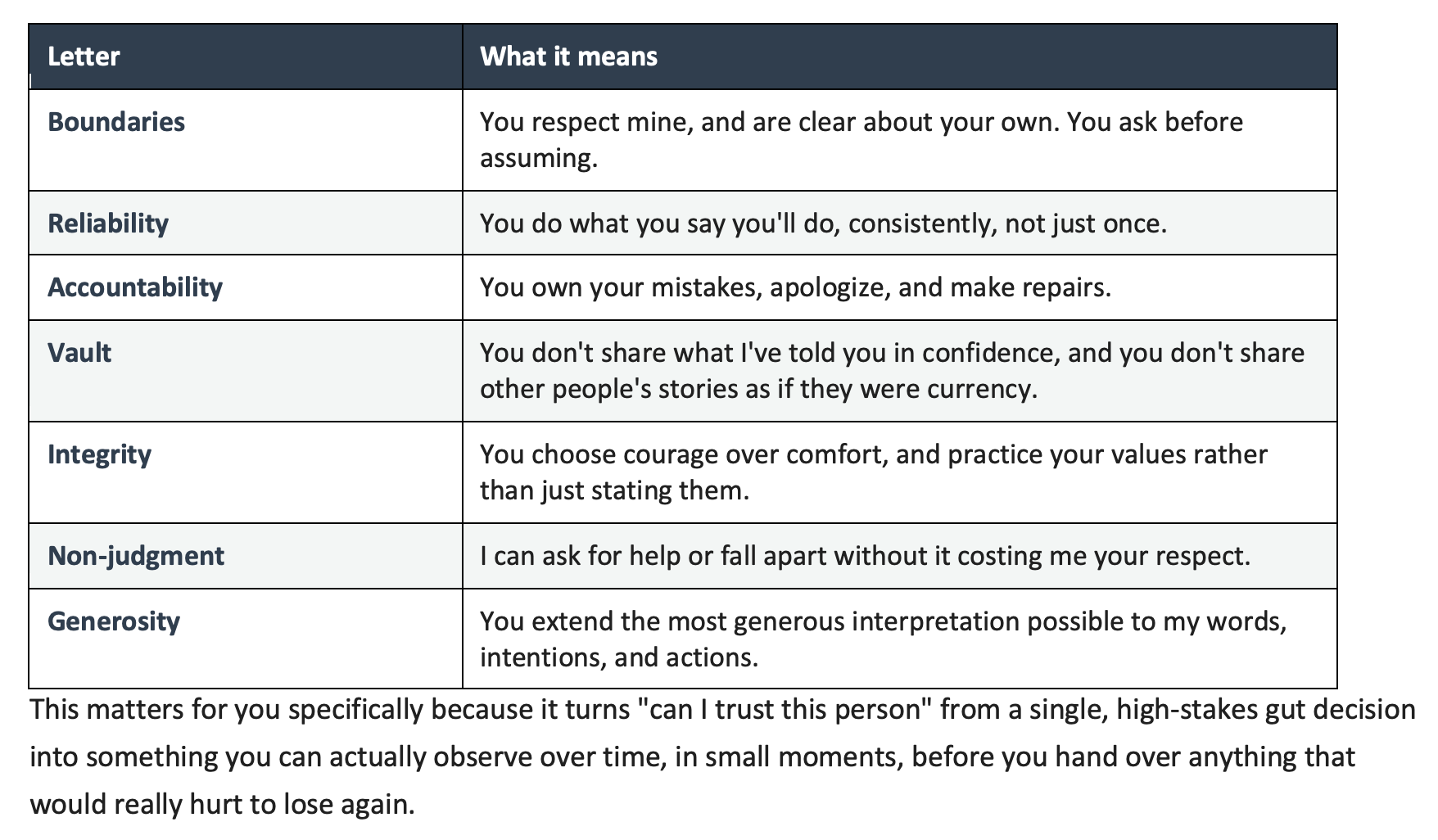
One reason vulnerability can feel so unsafe after a loss like this is that trust tends to get treated as all-or-nothing: either you trust someone or you don't. Brown offers a more useful way to think about it, breaking trust down into seven observable components, using the acronym BRAVING:
Boundaries — they respect yours, and are clear about their own
Reliability — they do what they say they'll do, consistently
Accountability — they own mistakes, apologize, and make repairs
Vault — they keep confidences, and don't trade in other people's stories
Integrity — they choose courage over comfort and live their stated values
Non-judgment — you can ask for help or fall apart without it costing you their respect
Generosity — they extend the most generous possible interpretation to your words and intentions
You don't have to stop being afraid first
Here's the part that tends to get missed: wanting closeness and fearing it are not contradictory. They can be, and usually are, true at the same time. The goal isn't to wait until the fear goes away before you let someone in. Brown's research is clear that courage and fear coexist. Courage isn't the absence of fear, it's moving forward with the fear still present.
So if you notice yourself wanting a real friendship while also flinching at the thought of needing someone, that's not a sign you're doing it wrong. It's a sign you're carrying something real, and it deserves patience rather than pressure.
A smaller, more manageable place to start: notice the armor as it goes on. And in low-stakes moments, with people who've actually shown you some evidence of being trustworthy, practice leaving a little of it off.
If you're finding it hard to let people in after a friendship loss, working with a therapist can help you sort through what belongs to the past and what's actually happening in front of you now. Visit francescawehrlcsw.com to learn more about working together.