
What It Means to Have Your Partner's Back
"He has never cheated on me. I just don't feel like he's on my side."
"She's completely faithful. But when I'm not around, I don't know what she says about me."
I hear versions of these sentences more often than you might think. They come from people who, by the usual definition, have nothing to worry about. Their partners are loyal. They don't flirt, they don't lie about where they've been, and they don't have secret accounts or hidden phones. And still, something feels off. The trust isn't quite there.
When we talk about trust in relationships, we tend to talk about fidelity first. That makes sense. Betrayal through an affair is one of the most painful experiences a couple can go through, and faithfulness is a real and important foundation. But if fidelity is the only way we define trust, we miss something big.
Trust is also the quiet confidence that your partner has your back. It's knowing that they care about your wellbeing, that your interests matter to them, and that when you're not in the room, they're still on your team. In other words, that they are your champion.
This post is about that deeper kind of trust: what it is, what the research says about it, how it's built and lost in small moments, and how to grow it.
Fidelity Is the Floor, Not the Ceiling
Faithfulness answers one very important question: Will you stay exclusive to me? It protects against one kind of betrayal. It doesn't tell us much about the rest of the relationship.
You can have a partner who has never strayed and who still:
Makes you the punchline when friends are around
Shares your private struggles without asking
Stays silent when someone criticizes you, even when they know the criticism is unfair
Makes big decisions without considering how they affect you
Treats your needs as an inconvenience
None of that involves another person. But all of it chips away at your sense of safety. And that safety is what trust is really about.
It can help to think of trust as having two parts:
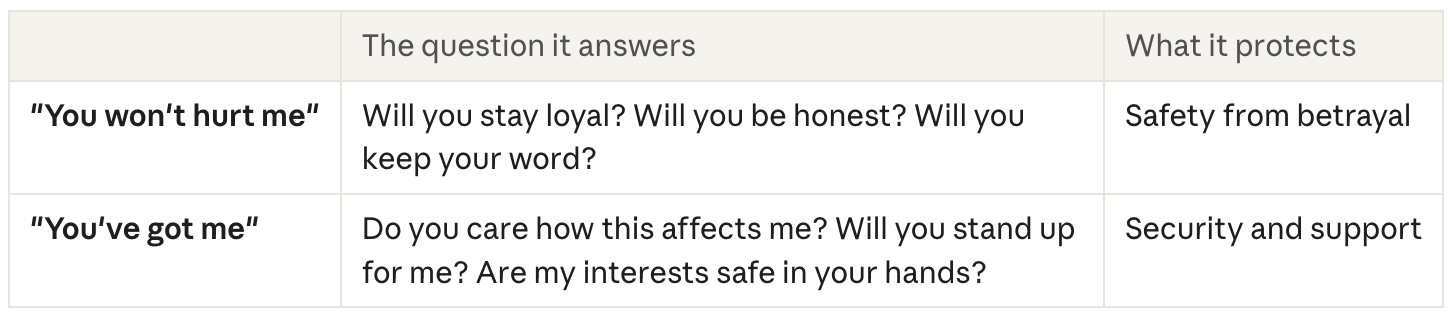
Fidelity lives mostly in the first row. A full sense of trust needs both.
This isn't a way to minimize infidelity, which can be devastating, or to suggest that a faithful partner is somehow falling short. It's an invitation to widen the lens. A relationship can be exclusive and still leave one or both people feeling alone.
What the Research Says Trust Is
Researchers have been trying to define trust in close relationships for decades, and two bodies of work fit this idea especially well.
Predictability, dependability, and faith
In 1985, psychologists John Rempel, John Holmes, and Mark Zanna published a widely cited paper on trust in close relationships. They proposed that trust has three parts:
Predictability. You have a sense of how your partner will act, based on what you've seen over time.
Dependability. You see your partner as someone who is honest and reliable, especially when something important or risky is at stake for you.
Faith. You feel confident that your partner will be responsive and caring in the face of an uncertain future, even when you can't point to proof.
The researchers described these as building on one another. Consistent behavior over time leads to a sense that someone is dependable. And that dependability lays the groundwork for faith, which is a kind of confidence that goes a step beyond the evidence in front of you.
Faith is the part that matches what many people describe when they say they trust their partner has their back. It isn't just "I know what you'll do." It's "I believe you'll be there for me, and that you'll care about what happens to me, even in situations neither of us can predict."
Having each other's best interest in mind
John Gottman and Nan Silver explore trust in their 2012 book What Makes Love Last? Gottman describes a "trust metric," a way of looking at how much partners believe the other is looking out for them. In his research, he found that couples with a higher trust metric tended to have more stable relationships. His description of what trust looks like in practice is helpful: even in the middle of a disagreement, you sense that your partner is still thinking about your welfare and your best interests.
Gottman also argues that betrayal is broader than infidelity. His book includes a chapter on other ways to betray a partner, and he notes that many of the conflicts couples have are, underneath, about trust: Are you there for me? Do you have my back? Can I count on you?
Put these two bodies of work together and you get a clear picture. Trust isn't only about what your partner won't do. It's also about what they will do on your behalf, and whether you believe their goodwill toward you is real.
The Champion Test
Who Are They When You're Not in the Room?
One of the clearest ways to see this kind of trust is to look at what happens in rooms you're not in.
When you're absent, your partner is still representing you. They represent you at dinners with their family, in conversations with their friends, in meetings at work, and in the small talk that happens at the end of a long day. You usually never hear most of those conversations. But you feel the effects of them in how people treat you, and in how safe you feel in your own relationship.
A partner who is your champion tends to:
Speak about you with respect. Even when they're frustrated, they don't turn you into a villain or a joke. If they need to vent, they do it in a way that doesn't tear you down or paint you as the problem.
Defend you. If someone criticizes you, mocks you, or makes an unfair assumption, they speak up, or at least they don't join in.
Protect what you've shared. Your fears, your history, and your private struggles stay in the circle of trust. They don't use them as material for storytelling or for winning an argument.
Celebrate you. They tell people about your wins, your strengths, and the things they admire about you. They aren't threatened by your success.
Consider you in their decisions. Plans, money, time, and commitments are made with an awareness of how they'll land on you, even when you're not there to ask.
Take your side in the larger story. This doesn't mean they agree with everything you do. It means they assume the best of you first, and they stay loyal to the relationship over the audience.
The flip side matters too. A partner who regularly makes you the butt of a joke, shares your private details without asking, or lets others speak poorly of you without a word may never break a single vow. But you may still sense that you're not fully safe with them. That sense is worth listening to.
One simple question can help you see it: If someone who knows us both were asked how my partner talks about me, what would they say?
What It Looks Like When You're in the Room
Being someone's champion isn't only about what happens behind the scenes. It shows up in how you treat each other face to face, especially in moments that carry some risk or cost.
Showing up when it's inconvenient. Trust grows when your partner is there on the hard days: when you're sick, grieving, scared, or not at your best. It's easy to be a good partner when things are easy. The days when it would be simpler to look away are the ones that count.
Welcoming your difficult feelings. Gottman's work points to listening to your partner's negative emotions as one of the most important ways to build trust. When you bring something painful to your partner, do they lean in with curiosity, or do they get defensive, change the subject, or tell you not to feel that way? Each time they lean in, your nervous system learns that your feelings are safe with them.
Turning toward small bids. Gottman describes "bids for connection" as small requests for attention, comfort, or shared moments. A sigh, a comment about your day, a hand held out. Couples who respond to these more often tend to build stronger bonds. Over time, these small responses add up to a very large amount of trust.
Staying on your team during conflict. Every couple argues. In a trusting relationship, there's still a sense underneath the argument that you're on the same side and that the problem is the problem, not each other. Even in the middle of disagreement, you can tell your partner is considering your wellbeing. They might be upset, but they aren't out to win at your expense.
Choosing the relationship over their own convenience. Trust is tested most when your partner's interests and yours pull in different directions. Does your partner ever give up something that matters to them, such as time, comfort, or being right, because it matters to you? Small acts of this kind, repeated, are what build faith.
Repairing after rupture. Nobody gets this right every time. What matters is what happens next. A partner who comes back after a hurtful moment, takes responsibility, and genuinely tries to understand your experience shows you something powerful: that you matter more than their pride. Repair is one of the strongest trust-builders there is.
Telling the truth, kindly. Being your champion doesn't mean telling you only what you want to hear. Honesty offered with care is a form of loyalty. It tells you that your partner respects you enough to be real with you.
How Trust Wears Down Quietly
When people picture broken trust, they usually picture a big event: a discovered affair, a major lie, a secret that comes out. Those are real and serious. But trust can also erode slowly, through patterns that seem small when you look at any single moment.
Some of the common ones:
Contempt, even in private. Eye-rolling, sarcasm, mocking, or treating a partner as beneath you. Gottman identifies contempt as one of the most damaging patterns in his research on relationships, and it's especially corrosive because it tells your partner they aren't respected.
Complaining outward instead of speaking inward. Everyone needs to vent sometimes. But when a pattern forms of confiding resentments to friends or family while keeping them from your partner, trust takes a hit. Gottman describes a slide in which private complaints turn into unfavorable comparisons with other people and eventually into closer bonds outside the relationship. It starts with something very ordinary.
Broken small promises. Forgetting a request, being late again, or saying you'll handle something and not following through. One slip means little. A steady pattern teaches your partner they can't count on you, which cuts at the dependability Rempel and colleagues describe.
Siding with others against your partner. Staying silent, or joining in, when a friend, a parent, or a coworker puts your partner down.
Sharing private things. Telling someone else about your partner's fears, past, or struggles without permission.
Withholding and secrecy. Hiding spending, minimizing a problem, or leaving out something important because it's easier than a hard conversation. These don't involve another person, but they still communicate "I can't be fully honest with you."
Withdrawing in hard moments. Going quiet, working late, or staying busy when your partner most needs you.
Putting yourself first, repeatedly. Everyone needs to meet their own needs, and that's healthy. Trust erodes when one partner's interests consistently win and the other's consistently lose.
No partner does all of this perfectly, and occasional lapses don't destroy a relationship. It's the pattern that matters, along with what happens after. A partner who notices, owns it, and changes course can rebuild trust. A partner who denies or minimizes keeps widening the gap.
There's one more thing worth saying here. When one person's trust has been quietly worn down, they often don't have a single event to point to, and that can make them doubt themselves. "Nothing really happened," they say. But the feeling is real, and it usually has a source. Naming the pattern is often the first step toward changing it.
Trust After You've Been Hurt
If you've been betrayed before, whether by a partner, a parent, a friend, or someone you depended on, this kind of trust can feel especially hard to give. That makes sense. When someone has let you down badly, your mind and body learn to scan for danger. You may find yourself watching for signs of disloyalty, bracing for the other shoe to drop, or struggling to believe that anyone would really look out for you.
There are a few things worth knowing.
Trust is built on evidence, not pressure. Nobody should be told to "just trust" their partner. Faith, in the research sense, develops after predictability and dependability have been shown over time. If you're rebuilding trust, it's reasonable to need to see consistent behavior before you feel safe. Brené Brown uses the image of a marble jar for this: trust is built one small moment at a time, as someone shows up and the marbles collect. A partner who understands this doesn't demand trust. They earn it, patiently.
Your history can color the present. If your earlier relationships taught you that people leave, lie, or turn on you, you may react strongly to a partner's ordinary mistakes. This isn't weakness. It's learning. It does, however, mean it can help to ask: Is this about what's happening now, or about what happened before? Often it's both. Therapy can help sort out which is which and help your nervous system update.
A champion is not a yes-man. Having your back doesn't mean agreeing with everything you say or do. Sometimes acting in your best interest means telling you something hard, setting a boundary, or disagreeing out loud. A partner who never challenges you may be avoiding conflict rather than supporting you. The difference is intent and tone. A champion tells you the truth because they want good things for you, and they do it with care.
Loyalty should never require silence about harm. Sometimes the language of "trust" and "loyalty" gets used to pressure someone into secrecy, to cut them off from friends and family, or to excuse behavior that hurts them. That isn't trust. A partner who truly has your best interest at heart doesn't need you to isolate yourself or to stop trusting your own experience. If something in your relationship feels frightening or controlling, support is available. In the US, you can reach the National Domestic Violence Hotline at 1-800-799-7233.
Building This Kind of Trust Together
The good news is that this kind of trust is built through ordinary habits. You don't need grand gestures. You need consistency, honesty, and a willingness to talk about it.
Talk about it directly. Many couples never discuss what "having each other's back" means to them. Try asking: What does it look like for me to be on your side? When do you feel most supported by me? When do you feel least? The answers are often surprising, and they give you something specific to work with.
Speak well of each other in public. Make it a shared practice to talk about each other with respect and affection when the other person isn't around. If you need to vent, pick someone who will help you work through it, not someone who will turn it into a case against your partner.
Take your concerns to your partner first. Before you share a grievance with someone else, try saying it to the person it concerns. It's a small habit, and it protects the relationship from the slow drift that happens when resentments find an audience elsewhere.
Keep small promises. If you say you'll call, handle the errand, or be home at six, do it. If you can't, say so early and don't let it go quiet. Small, reliable follow-through is the raw material of dependability.
Turn toward each other's bids. Notice the small attempts at connection, and respond to them. You don't have to meet every one perfectly. You just need to meet them often.
Make space for hard feelings. When your partner shares something painful, listen first. Skip the fixing, the defending, and the "at least." Something like "That sounds really hard, tell me more" can do a lot.
Repair quickly and sincerely. After a hurtful moment, come back. Name what you did, acknowledge how it landed, and ask what would help. A genuine repair can leave trust stronger than before the rupture.
Say it out loud. Many partners assume the other already knows they're on their side. Tell them. I've got you. I'm on your team. I'm thinking about what's good for you here too. Hearing it matters.
Check in regularly. Set aside a regular time, even 20 minutes a week, to ask how the relationship is going. What felt good? What felt off? Where did you feel supported, and where did you feel alone? Gottman's approach includes structured check-ins of this kind, and couples often find that a predictable space makes it easier to raise things before they pile up.
If you're working through a rupture in trust, or if these conversations tend to go badly on your own, couples therapy can offer a calmer space and some tools to get unstuck. Trust can be rebuilt, and it's often rebuilt in the same way it was first formed: through repeated, reliable moments of showing up.
Questions to Sit With
Whether you're thinking about your own relationship or about the kind of partner you want to be, these questions can help. You can reflect on them alone or talk through them together.
When I'm not in the room, do I believe my partner speaks about me with care?
Do I feel that my partner considers my wellbeing when making decisions that affect us both?
When I bring them something hard, how do they respond? How do I feel afterward?
In what moments have I felt most on my own in this relationship? What was happening?
How do I speak about my partner when they aren't around? Would I be comfortable if they heard it?
What is one small thing I could do this week to show my partner I'm on their side?
A Final Thought
Fidelity matters, and it will always be part of trust. But a relationship where no one has strayed isn't automatically a relationship where both people feel safe, valued, and defended.
The trust that changes people's lives is the quieter kind. It's the belief that someone is on your side. That when you walk out of the room, your name is safe in their mouth. That your wellbeing sits somewhere close to the center of their thinking, even when you disagree, and even when no one is watching.
That kind of trust can be built, and it can be repaired, one small act at a time.
If you'd like support building it in your own relationship, whether you're working through a break in trust, feeling alone inside a partnership, or simply wanting to understand each other better, you can learn more about working together on my website at francescawehrlcsw.com. I offer online therapy to clients in New Jersey, Virginia, and Florida.
This post is for general education and is not a substitute for individual mental health care. If you are in crisis, please call or text 988 (in the US) or go to your nearest emergency room.



References
Gottman, J. M., & Silver, N. (2012). What Makes Love Last? How to Build Trust and Avoid Betrayal. Simon & Schuster.
Rempel, J. K., Holmes, J. G., & Zanna, M. P. (1985). Trust in close relationships. Journal of Personality and Social Psychology, 49(1), 95-112.