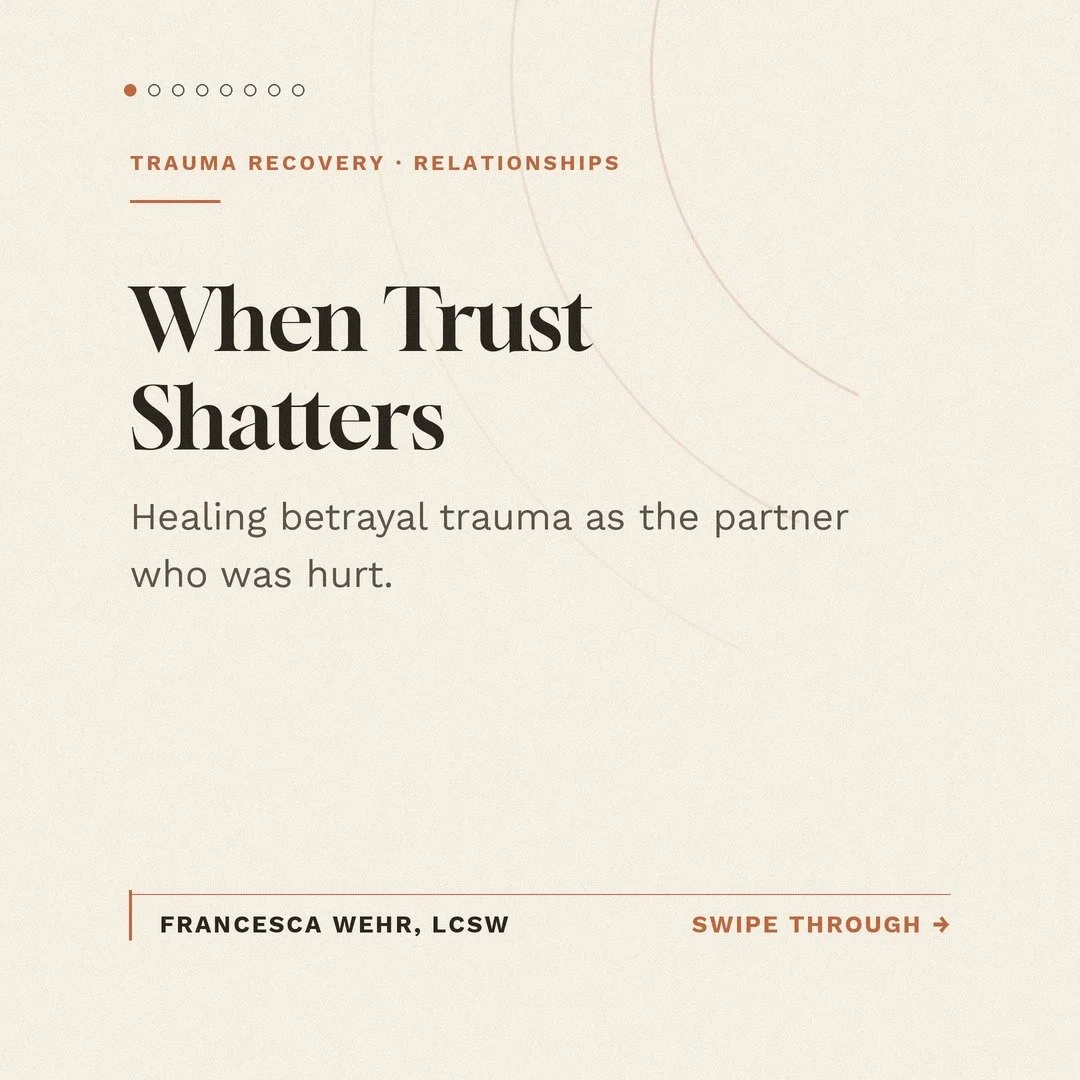
When trust breaks in a relationship, the damage reaches far past the behavior that caused it. I work with a lot of partners who caused that kind of injury, and what I hear most often is confusion mixed with urgency. They want to fix it, fast, and they're carrying a lot of shame while they try.
I want to say this clearly from the start. Repairing betrayal trauma isn't about punishing yourself or proving your worth. It's about learning how to stay emotionally present in the face of the harm you caused, and about building the kind of conditions where safety can slowly come back.
Understanding the Impact Without Collapsing Into Shame
When infidelity or secrecy comes to light, the injured partner's nervous system usually shifts into survival mode. Their sense of safety, predictability, and shared reality has been genuinely disrupted, and that's not something they can just decide their way out of.
If you're the partner who caused that injury, witnessing this kind of pain can bring up a lot in you too. It's common to feel:
Overwhelming shame
Fear that this means the relationship, or you, are unforgivable
Defensiveness or the urge to withdraw
Urgency to make the pain stop, right now
A pull toward wanting to be forgiven quickly, so the discomfort ends
Here's something important to understand about shame. It narrows your emotional capacity. When shame takes over, it becomes genuinely hard to stay present, to listen without getting defensive, or to tolerate your partner's pain without needing it to resolve immediately. Repair actually starts when you can acknowledge that shame in yourself and work to regulate it, rather than avoiding it or, without meaning to, projecting it back onto your partner.
Accountability Without Losing Yourself in It
Taking responsibility doesn't mean you have to define your entire identity around the harm you caused. It means being able to say things like:
"I made choices that caused real harm."
"I understand this changed how safe you feel with me."
"I'm willing to face the full impact of what I did."
Accountability becomes something that actually heals a relationship when it's steady, consistent, and free of defensiveness. It stops being helpful when it's driven mostly by guilt or fear, because those emotions tend to pull the focus back onto you instead of staying with your partner's experience.
Why Emotional Presence Matters More Than Explaining Yourself
After betrayal, a lot of people try to repair things by explaining their intentions or what was going on for them emotionally at the time. Context can matter later on, but in the early stages of healing, what your partner needs from you is attunement, not justification.
Emotional presence looks like:
Listening without interrupting or correcting their version of events
Letting them express what they're feeling without rushing them toward resolution
Naming the injury honestly, without softening or minimizing it
Staying engaged even when the conversation is uncomfortable for you
This is genuinely how safety starts to come back, and it happens at a nervous system level before it happens intellectually. Your partner's body needs to experience you staying, over and over, before their mind can catch up and believe it.
Predictability and Transparency as a Form of Regulation
Once trust is broken, unpredictability itself becomes threatening. Transparency, in this context, isn't about surveillance or proving you have nothing to hide. It's about restoring reliability.
In practice, that might look like:
Offering information before your partner has to ask for it
Making sure your words and your actions actually match
Following through on the commitments you make, even the small ones
Accepting temporary boundaries without resenting them or making your partner feel guilty for needing them
Over time, these repeated experiences of predictability teach your partner's nervous system that the environment is becoming safer again. That learning happens slowly and through repetition, not through a single conversation or gesture.
Letting the Healing Timeline Be What It Is
Healing doesn't move in a straight line. Triggers can show up out of nowhere. Your partner's reactions might feel disproportionate to whatever prompted them in the moment. None of that means repair is failing.
What repair actually asks of you is:
Patience when things feel like they're regressing
Willingness to revisit conversations you thought were already settled
Emotional steadiness during setbacks, even when you're tired of having the same conversation
Trust that consistency matters far more than speed
You can't rush a nervous system back to feeling safe. It happens on its own timeline, and trying to force it usually just adds more strain.
Repair Is Demonstrated, Not Promised
Change isn't proven through reassurance or good intentions, even sincere ones. It's demonstrated through:
Behavioral shifts that hold up over time
A genuine willingness to seek support, whether that's individual or couples therapy
Ongoing self-reflection, not just in the immediate aftermath but well after
Increased emotional availability in everyday moments, not just crisis ones
Owning your missteps and repairing them when they happen, rather than getting defensive
Safety gets rebuilt through patterns. Not through perfection, and not through a single grand gesture.
A Closing Thought for the Partner Who Caused the Injury
Repair takes real emotional courage. It asks you to stay present with pain you didn't experience directly, without withdrawing and without collapsing into your own shame.
When repair is done well, your partner slowly starts to experience something new. Something closer to, "you can tolerate my pain," "you are actually here with me," and "I'm not alone with this anymore."
That's how trust begins to re-form. Not all at once, but through the accumulation of moments where you chose to stay.
If you're navigating this kind of repair and want support finding your way through it, I'd be glad to help.